

EAC
Sunday, June 15, 2014
Swala offers EAC shares to raise $3m
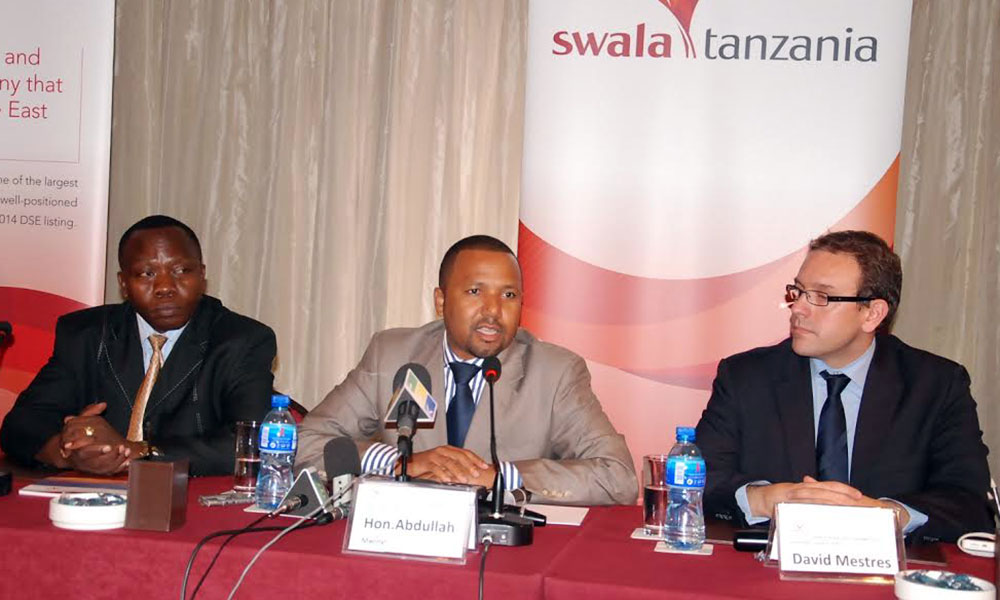
The Director of Swala Oil and Gas Company, Abdullah Mwinyi (Centre) talks to stakeholders
East African residents will be given ownership of Swala Oil and Gas Tanzania Plc if the shares offloaded for Tanzanians will be remained.
Swala has offloaded 9.6 million ordinary shares to Tanzanians at a price of Tsh500 ($0.297) per share to raise up to Tsh4.8 billion ($2.85 million), this amount is before costs and expenses.
The official launch of Swala’s Initial Public Offer comes a week after the company received its official approval from the Tanzania Capital Markets and Securities Authority (CMSA), making it the first of such offering in the oil and gas industry in East Africa.
Swala Chief Executive Officer, David Mestres Ridge told East African Business Week in Dar es Salaam last week that this is a great step not only for Swala but also for Tanzania and its people.
“Investing in oil and gas shares is means for economic diversification for any individual and it allows interested parties to own a stake in a fast growing business,” Ridge said.
Ridge said they are grateful to the government of Tanzania, Tanzania Petroleum Development Corporation (TPDC) and the CMSA for allowing them to become East Africa’s first public owned oil and gas company.
On his side, Mr. Abdullah Mwinyi, the company’s Director said there has been a great debate on the need for local content in this booming oil and gas industry.
“We are delighted today (last week) Swala would become the first oil and gas company to walk the talk, he said adding that we strongly believe Tanzanians should be given an opportunity to participate in the oil and gas business.”
Mwinyi told East African Business Week that this Initial Public Offer opening allows them to do just that.
“Tanzanians will be given first priority to buy shares and residents from East Africa will follow, he said adding that we will ensure applicants from Tanzania are first shortlisted.”
He said the offer is open from 9th June to 4th July 2014. There is currently no maximum subscription limit, but a minimum subscription of 100 shares per person is required.
According to Mwinyi, who is one of the Tanzanians that own 35% of shares in the company said the preliminary findings show that there are significant signs of having oil. The parent owner from Australia has 65%.
In another development, Swala committed to entering the second 2-year exploration phase of the initial exploration term in both its Pangani and Kilosa-Kilombero Production Sharing Agreement (PSA) licence areas, together with its Joint Venture partner Otto Energy, a wholly-owned subsidiary of Otto Energy Ltd.
Under the terms of the PSA Swala could have withdrawn after both the first and second years of the initial exploration term should exploration results have proved disappointing.
Swala’s decision to proceed into years 3 and 4 in both licence areas was supported by the encouraging results observed following interpretation of Swala’s 2012 airborne gravity and magnetic survey that was followed by the highly successful 2D seismic campaign undertaken during 2013, where 5 significant prospective hydrocarbon basins were investigated by the acquisition of 563km of data.
The work commitment in this next period includes additional seismic acquisition and the drilling of 1 exploration well in each of the two areas to be completed before the end of February 2016.
Swala is an affiliated company to Swala Energy Limited, accompany in turn listed on the Australian Stock Exchange with ticker ‘SWE’.
Swala holds assets in the world-class East Africa Rift System with a total net land package in excess of 17,500km2.
New discoveries have been announced by industry participants in a number of licenses along this trend, including Ngamia and Twigga, which extend the multi-billion barrel Albert Graben play so successfully developed by Tullow Oil into the Eastern arm of the rift.
Swala has an active operational and business development programme to continue to grow its presence in the hydrocarbon provinces of East Africa.
By Leonard Magomba, Sunday, June 15th, 2014