

Leisure
Monday, June 16, 2014
Brazil 2014, a world cup of ‘firsts.’
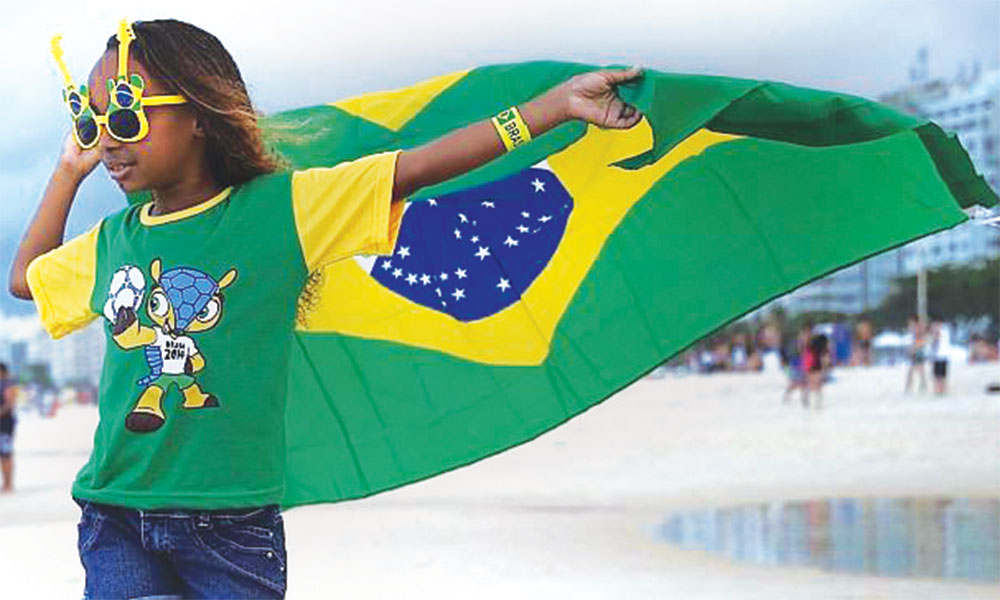
Four years, turned to a year, then months and finally the largest single sports event and most-watched competition on earth, the World Cup is finally underway.
Here are a few facts that you need to know about the 2014 FIFA World Cup. It is laced with many firsts;
Merely at the beginning of the event, the tournament has already inked itself in history books.
It is the first time that two consecutive World Cups are hosted outside Europe.
Also, it is the first world cup to have goal line technology used.
It is the most expensive World Cup (close to $16b) has so far been used in preparing for the tournament at this soccer crazy nation.
A paraplegic teenager paralyzed from the waist down took the first kick of the tournament with the aid of motion sensors.
A further dissection of the 2014 tournament reveals that the host, Brazil Is ‘The Most Expensive Team’ in the 2014 World Cup.
According to Pluri Consultoria, Brazil is the most expensive team that is participating in the World Cup. They based this on calculating the market value of its squad members. Brazil has a market value of 507,8 million euros. Spain is the 2nd most expensive participant with a market value of 504 million euros and Argentina completes the top 3 with 475,2 million euro market value.
The report also further reveals that Lionel Messi Is ‘The Most Expensive Player’ in the 2014 World Cup. Pluri Consultoria, based this again on calculating the market value. Lionel Messi has a market value of 139,6 million euros. Cristiano Ronaldo is the 2nd most expensive player with a market value of 104,2 million euros and Neymar completes the top 3 with 67,4 million euro market value.
In terms of rewards, the 2014 World Cup global show piece also chalks up massive incentives to the successful nations. The Champion Will Win $35Million. This amount is higher than what Spain, the 2010 World Cup winners won four years ago. At the tournament in South Africa, Spain took home $31m. FIFA secretary general Jerome Valcke is quoted by the press as saying that the runners-up of the 2014 edition will claim $25m.
The team winning the match for the third place will win $22m while the fourth placed nation will win $20m. Each country that makes it to the knock-out stage will receive a guaranteed minimum of $8m.
The total amount of money available for participating countries is $576m. In the 2010 show piece, the amount was $420m. The countries will receive a total of $100m for making their players available for the tournament.
Furthermore, for the first time in World Cup history, vanishing spray is being used by referees in the 2014 World Cup. The water-based spray is used to mark the position of the ball for a free-kick on the pitch. The spray is also used mark the ten-yard line for the defending team during a free kick. This prevents players from forming a defensive wall too close to the ball. The spray appears as a white spot or line that automatically disappears in a minute.
FIFA approved the spray for the 2014 World Cup after it was successfully used at the 2013 FIFA U-20 World Cup, 2013 FIFA U-17 World Cup and 2013 FIFA Club World Cup.
Another interesting fact is that three nations will have to travel more than 14,000km during the tournament. According to Brazilian newspaper Estado de SP, USA, Italy and Mexico are the only countries which will travel more than 14,000 km given that most of the host cities are far away. Belgium on the other hand will only travel 1,984 kilometers for their group matches. This is far below the 7,525 km average for the 32 teams. Argentina will only travel 3,590 kilometers for their three group matches. Host country Brazil’s air miles are the closest to the 7,525 km average.
Bosnia And Herzegovina Is The Only Country To Have Qualified For The First Time. In the 2010 World Cup, every team had already participated at a World Cup before. This was the first time this had happened. In the 2014 edition, Bosnia and Herzegovina qualified for the very first time. They qualified directly and topped group G of the UEFA qualifications. Their opponents are Argentina, Iran and Nigeria.
Compiled by Emma Onyango
By Emma Onyango, Monday, June 16th, 2014