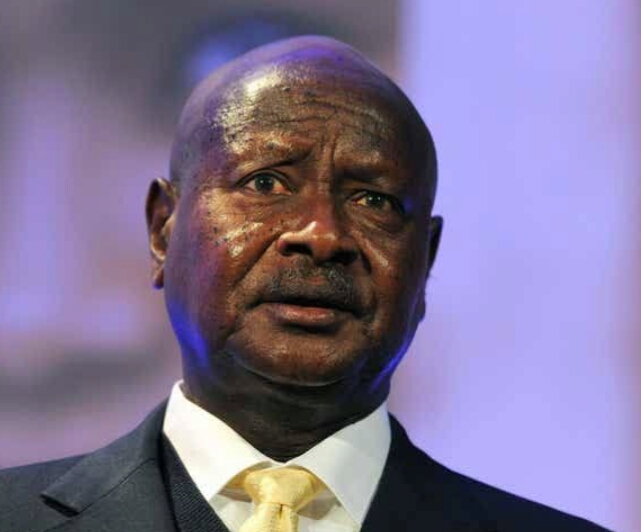
Uganda’s President Yoweri Museveni has this morning opened the 10th East African Petroleum Conference and Exhibition 2023 (EAPCE’23) with a call to climate change activists to put into consideration that all measures aimed at protecting the environment must conform with the principle of equity.
The President said as the East Africa region and Africa in general, they do recognize that the threats posed by
climate change are real and support measures aimed at protecting the environment.
“But such measures must conform with the “principle of equity and common but differentiated responsibilities and respective capabilities, in the light of different national circumstances” as enshrined in the Paris Climate Agreement as this principle was key in assuaging the fears of developing countries, especially oil and gas producing countries, in the early years of the climate negotiation process,” said President Museveni.
President Museveni who was speaking at the Kampala Serena Hotel said the East African Community as a region is aware of a global push for energy transition, which means moving away from the use of fossil fuels to Renewable Energy.
“We believe that if the developed countries want to, they can develop and commercialize technologies that will make fossil fuels good for use,” he added.
The push for energy transition is coming at a time when the EAC region has established significant petroleum that can greatly contribute to the economies of the region.
In order to utilize these resources and those that may be discovered in the future, the EAC came together and developed a strategy on regional refineries development in 2008. The strategy addresses development of refineries and other infrastructure required to enhance storage and distribution of petroleum products in the region.
This strategy President Museveni said identified the need for a refinery in Uganda upon confirmation of the commercial reserves of the oil discoveries.
“The Government of Uganda is now progressing the development of the refinery,” he said.
President Museveni said that the Conference and Exhibition is one way of promoting the petroleum potential and investment opportunities in the oil and gas sector in East Africa.
“These conferences provide awareness of the potential for petroleum exploration, development and production, and an opportunity to dialogue between oil and gas industry and governments of EAC.
“The EAC partner states will use this opportunity to demonstrate to the world the potential that lies within the Region, sharing information on the status of the sector in each partner state including the policy, legal and regulatory framework, and the overall business environment prevailing in the region.
“With regard to other subsectors under energy, we have important projects and programmes that we are pursuing as the EAC. In the power sub sector, we are developing a regional power master plan that will identify generation and transmission needs to satisfy our electricity demand for the next twenty-five (25) years,” said President Museveni.
To address this need, Presdent Museveni said the region plans to develop both the local resources and also to interconnect with countries outside East Africa.
“The EAC partner states are making major investments in the power sector and creating robust institutional arrangements to avoid the mistakes of the past when we suffered serious power shortfalls.
“In Uganda, we are pursuing an aggressive programme to develop nearly 52,000 megawatts of hydro power by 2040. I am aware that Kenya is pursuing an equally aggressive programme for the development of geothermal resource of power generation while Tanzania is increasing its power generation from natural gas. Rwanda, Burundi and South Sudan equally have plans to continue generation power from a diverse energy mix,” said President Museveni.
He added that there are major electricity projects to interconnect all the east African countries going on and expect to have a fully interconnected East African power network.
“In addition, efforts to interconnect with other regions are being pursued notably to the North through the Ethiopia- Kenya interconnection between Tanzania and Zambia,” said President Museveni.
In addition to the development of mainstream power generation resources, promotion of renewable energy is equally important, President Museveni said they have programmes on wind, solar and sustainable biomass for grid and off grid systems.
“These renewable resources have the potential of being small scale for isolated off grid communities. As EAC, we will develop a common energy policy and back it with a protocol that will define the regional framework to support the
development of the energy sector,” he noted.
President Museveni said that currently, there are only thirty-seven (37) international oil and gas companies licensed to carry out petroleum prospecting in the region.
“In addition to oil and gas prospecting, there are investment opportunities in the mid-stream and downstream sub sectors. These include infrastructure projects and processing facilities necessary to support the industry. In
Uganda, development of EACOP and Upstream projects is steadily progressing and Refinery Project is also taking shape,” he stressed.
President Museveni said that under the East African Community, they are taking steps towards continually improving the business environment by addressing policy, security, legal, and regulatory frameworks in all sectors. “In fact, this conference is taking place at time when the integration process for the EAC partner states has gained momentum.
“Our integration programme has four key milestones: Customs union, Common market, Monetary union and Political federations. These four (4) pillars of integration are the pivot around which integration in all sectors
within East Africa is taking place.
“I assure you that the political leadership in east Africa is fully committed to the full integration of east Africa. We
have already achieved the customs union and common market. The Customs union makes East Africa a single customs territory while the common market protocol enables the free movement of labor, services
and capital with in east Africa as a one market.
“The central banks and institutions responsible for macro-economic affairs in East Africa are working together to achieve macro-economic convergence with in the region as part of the efforts towards the East African Monetary Union.
“The oil and gas sector does not operate in isolation. The development of the other enabling infrastructure is crucial for attracting more investments in this sector,” said President Museveni.
BY PAUL TENTENA